

Preparing Sacred Space
At Myers Park Presbyterian Church in Charlotte, North Carolina, Lent always arrives with intention. In a large church bustling with thousands of members, Lent is a time when many in the church join a new study. The season invites people to slow down long enough to reflect on suffering, loss, and the long journey toward Easter hope.
For Bess Kercher, that preparation took the form of the Story Circle. For her, preparation began before anyone else entered the room.
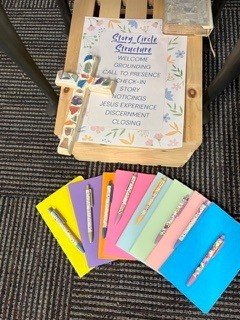
Each week, she arrived early, carrying armfuls of small things that together transformed an ordinary church meeting room into sacred space. She lowered the lights and adjusted the blinds against the brightness outside. In the center of the room, she placed a small dark green table she had found at a consignment shop. On top sat a candle, flowers clipped from her yard, a framed call to presence, a stone engraved with the word “breathe,” and a Bible beneath a cross made from shattered pieces of pottery gathered after a youth retreat years earlier. During one of the final weeks of the Story Circle process, the group reflected on Mary witnessing the death of Jesus. For that week, Bess placed a single white rose beside the cross.
Outside the room, the church moved at its normal pace. Inside, the women slowly took their seats, circled around the table, and settled into silence.
The Story Circle group came together as part of a Lenten study, women from different stages of life, some close friends, others only vaguely familiar faces from such a large congregation. Together they practiced generous listening, learning to resist the instinct to interrupt, affirm, analyze, or fix. The structure asked something unusual of them. To listen fully. To trust silence. To hold another person’s story without needing to control it.
The group was committed to the process. Deanie spent nearly the entire season trying to get there. She had undergone knee replacement surgery just before the group began and reached out to Bess. Every week she planned to come. Every week, something intervened. Physical therapy appointments shifted. Pain intensified during the night. Some mornings, she simply could not move well enough to leave home. But each week she reached out again, apologetic and determined, insisting she still wanted to be part of the process.
Finally, near the end of the process, she made it into the room. That evening’s Story Circle focused on suffering, death, and loss through the eyes of Mary. Bess had struggled all week preparing to tell the story herself. As a mother of two sons, she could barely practice the reading without crying.
And then, as the group began reflecting together, the woman who had trouble getting to the sessions quietly shared something none of them knew.
Tomorrow was the anniversary of her mother’s death.
She admitted she had spent weeks resisting the grief, trying not to fully feel it. Now somehow, after all the weeks she had been unable to come, this was the day she had finally made it into the circle. The room gasped. Several women began crying immediately. Others reached for tissues. No one rushed to explain the coincidence away. The moment simply settled over the room with the weight of something holy.
By then, the women had spent weeks learning how to be present to one another differently. They had practiced slowing down long enough to really listen. They had learned to let silence linger without rushing to fill it. Week after week, stories had been shared and carefully held inside that circle. So, when grief finally arrived fully in the room that night, it did not feel intrusive. It felt received.
For Bess, it became one of many moments throughout the process when the careful practices of Story Circle, the intentional preparation of sacred space, and the movement of the Spirit seemed to meet one another all at once.
Inside that small circle, surrounded by flowers, candlelight, silence, and stories, grief had been given somewhere to arrive. And in the middle of Lent, a season meant to draw people deeper into the suffering of Christ before the hope of Easter, the women found themselves doing exactly that together, not as an abstract spiritual idea, but as something tender, human, and painfully real.